Not all Contact Cements are Created Equal!
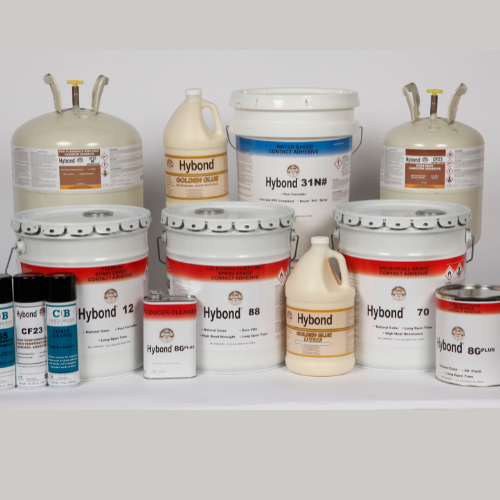
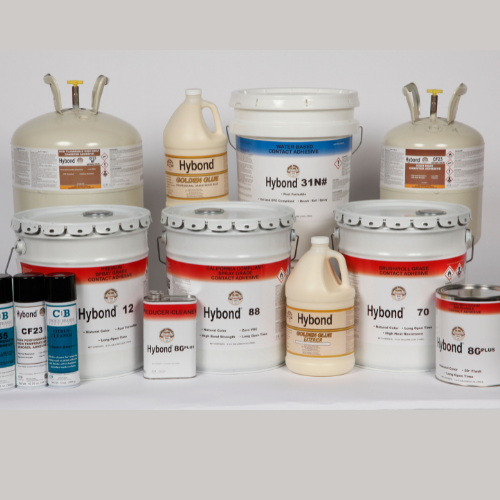
Why you might actually be spending more with a cheaper contact adhesive, and how to calculate your true square foot cost.
Our industry is getting more competitive every day. Margins are thinner than they’ve ever been, labor costs are increasing, and trying to find a competitive edge to boost margins while winning bids and staying competitive is necessary. We’re here to point out a way that savings, without compromising on value, might be hiding in your contact adhesive.
What if we told you that a more expensive bucket of glue could lead to lower per-square-foot spraying costs and increased shop efficiencies?
If you’re only looking at the cost of a pail or drum of glue, without considering many other factors, you may actually be spending more per square foot instead of less. How can it be possible that a cheaper cost per gallon leads to a higher glue cost per square foot?
Let’s start by looking at what makes up contact cement.
Four Main Components in a pail or drum of contact adhesive:
- Carrier, which is solvent(s) or water
- Rubber, which provides strength
- Resin, which provides tack
- Antioxidants, which allow for aging
In the above formula, the rubber, resin, and antioxidants are called “solids”.
For this discussion, the carriers used will be solvent-based.
The carrier can be sprayed, brushed, or rolled onto the substrates to “carry” the solids mixture. Once the carrier has done its job, it evaporates or “flashes off”. Once the flashing process is complete, the two substrates can be mated together to form a bond.
There are different types of rubber, resin, and antioxidants used in contact adhesives. Depending on the makeup of the three, along with the carrier, there are limitations to the amount of solids that can be mixed into the formula.
As a general rule for contact adhesive, the higher the solids content in the formula, the more square footage you can bond. Reminder: Solids are a combination of rubber, resin, and antioxidants used in a glue formula.
Types of Rubber in Contact Cement
- Neoprene is one of the most commonly used synthetic rubbers in the manufacture of contact cement.
- It has many good qualities, but because of its nature, most neoprene contact cements on the market contain only 17%-20% solids.
- Premium-grade neoprene-based contact adhesives are manufactured for post-forming operations, and economy-grade neoprene-based adhesives are manufactured for “flat work” only.
- Due to the limitations on solids for Neoprene, it’s common to see bonded square feet per gallon between 130 to 145.
- SBR is another type of synthetic rubber used for contact cements.
- It also has many good qualities, and due to its nature, SBR-based contact cements can have as much as 37% solids
- Contact cements with SBR can bond up to 275 square feet per gallon.
- SBR-based contact cements are for flat work only.
Please keep in mind that the square foot numbers above are for “bonded” material.
Contact cement needs to be applied to both the material and the substrate, such as HPL laminate to particle board. This means you’re actually applying twice the amount of adhesive, 260 to 290 square feet, before making a bond of 130-145 square feet.
As a general rule, SBR-based contact cements bond significantly more square footage per gallon than neoprene-based because of the increased solids in SBR-based adhesives.
As a general statement, because there is more adhesive (solids) in a pail or drum of SBR contact cement, that pail or drum costs more than a pail or drum of neoprene contact cement.
Most purchasers buy based on the cost of a pail or drum, but what’s the coverage? With this thought process, You might be saving on the bucket, but actually spending more per square foot. Bucket or Drum cost is not the best way to evaluate your true cost for contact cement.
You pay for laminate, board and other substrates by the square foot. Wouldn’t it be better to know your actual bonded square foot cost for contact cement, too?
Here’s an easy way to calculate:
Most contact cement manufacturers have Product Data Sheets for each product they manufacture. Locate the PDS for the contact adhesive you are using and look for coverage rate. Additional helpful details included on the PDS such as viscosity, dry time, open time, available colors, VOC content, shelf life, packaging, flammability and yes, solids content.
To figure out your bonded square foot cost for adhesive, take your cost per gallon and divide it by the coverage rate.
Example: Manufacturer X economy grade neoprene cost per 5 gallon pail is $115. According to Manufacturer X economy grade PDS, it bonds 131 square feet per gallon. $115/5 = $23 per gallon. $23/131 = $.176 per square foot for bonded material.
Manufacturer Y SBR cost per 5 gallon pail is $225. According to Manufacturer Y PDS, it bonds 275 square feet per gallon.
$225/5 = $45 per gallon. $45/275 = $.163 .
|
Values |
Manufacturer X Economy Neoprene |
Manufacturer Y SBR |
|
Shop Cost per Bucket (5 Gal) |
$115.00 |
$225.00 |
|
Cost per Gallon |
$23.00 |
$45.00 |
|
Coverage Rate per Gallon |
131 |
275 |
|
Cost Per Square Foot |
$0.176 |
$0.163 |
In this example, with real costs and coverages, the lower-cost bucket is actually more expensive per square foot. While a purchaser may see $100/bucket in savings, it’s also important to consider order frequency and how long each bucket lasts.
Less coverage means you’re going through buckets faster, ordering more, and leaving more empty 5-gallon buckets or drums, resulting in lost efficiencies. Additionally, SBRs often spray better and flash quicker so the shop can work faster, too.
We’re all looking for ways to find savings without sacrificing value and improve efficiency, and there might be some savings hiding in your contact adhesive. We know, even with potential savings, switching glue can be a scary thing. We’re here to help make the process smooth, efficient, and something you can stick with long term.
Need help figuring out your coverage or interested in testing out one of our Hybond contact adhesives? Contact Us! We’re here to help.
We’d like to thank our guest contributor on this article, Clark Benson of CB Sales and Marketing, for sharing his insights gained from analyzing glue costs and selling Hybond adhesives for 10+ years, and making comparing costs a simple exercise!